1. INTRODUCTION
When buying a diamond, you need to be aware of various grading laboratory standards that surround it. Without those clarity grades, buying a diamond would be a waste. This article aims to help you understand various grades of a diamond so that you can make an informed decision when buying one.
Understanding what makes diamond grading laboratory standards reliable is an important step toward making a confident purchase. Buyers can gain valuable Makes Diamond Grading Laboratory Insights by looking at factors such as certification authority, grading consistency, transparency, and the qualifications of the gemologists involved. These elements help establish whether a grading report provides an objective assessment of a diamond’s characteristics and gives buyers a clearer basis for comparing diamonds, quality, and value.
2. THE AUTHORITY OF CERTIFICATION
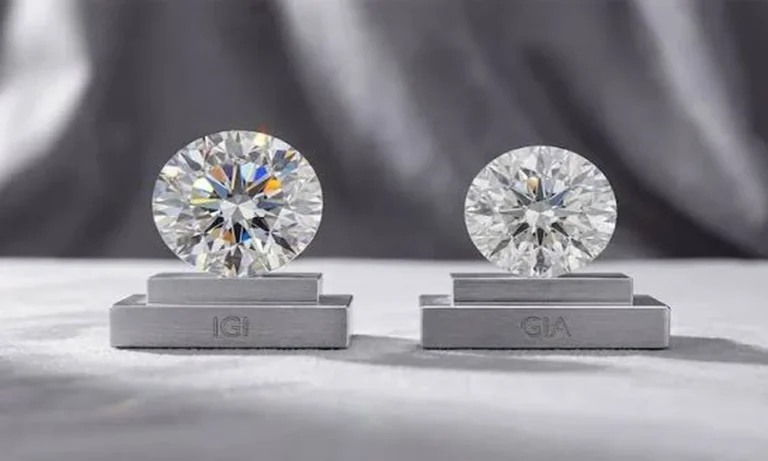
An impartial assessment of the 4C’s is provided by independent certification, as it fosters an essential trust and ensures price transparency in the market. A comprehensive grading report is accompanied by a certified diamond, where the leading gemological laboratories follow standardised grading protocols. This entire process relies on expert gemologists.
3. GIA DIAMOND GRADING REPORT
A detailed profile of the diamond is provided, where each feature is observed with the help of magnification by GIA diamond report:
- Report No: On the diamond’s girdle, a distinct identifier is often laser-inscribed.
- Shape and Cutting Style: The exact geometry and facet arrangement of the diamond is confirmed.
- Measurements: Correct dimensions are provided in millimetres.
- Four C’S: The guaranteed grades for clarity, colour, cut and carat weight.
- Comments: Extra information regarding specific proportions, fluorescence and other unique features is provided.
- Clarity Plot: The nature and location of inclusions is provided by a detailed diagram.
You can thoroughly understand a diamond with this grading report, as it precisely matches certified specifications and eliminates any uncertainty.
4. AGS GRADING
A distinct 0-10 numeric scale for cut grading is provided by the American Gem Society, where 0 means an ideal cut, and 10 means a poor rating. A strong emphasis is placed on the analysis of light performance, where advanced metrics such as actual light return measurements and ASET imagery are provided.
5. AGS, AGS DIAMOND GRADING SYSTEM (2024)
Both natural and lab-grown diamonds are widely recognised by the expertise of the International Gemological Institute. Similar strict rules are applied by the IGI to the synthetic ones, where their specific growth method is noted down. Invaluable clarity is provided to the buyers in their detailed reports, where popular eco-friendly or budget concious lab grown optionsare considered by facilitating informed decisions across the entire variety of diamond types.
6. MARCEL TOLKOWSKY
The definitive ideal cut proportions in the year 1919 was first published by Marcel Tolkowsky who was a pioneering gemologist and mathematician. The critical angles and percentages required to achieve light performance was was rooted in his work, where the principles of optical physics and vast studies of human work is stated.
7. GRADING LAB-GROWN DIAMONDS
Similar to natural diamonds, lab-grown diamonds are also subjected to the same strict grading criteria since it ensures a consistent and unbiased evaluation of the 4 C’s. Carbon crystals are produced by advanced synthesis techniques where gemologists assess with unwavering objectivity without considering their origin.
8. CONCLUSION
To conclude, ensure that the diamond you buy has the necessary grading certifications as mentioned above so that it has value. If you want, you can also seek the help of an expert when you buy one so that you don’t get fooled.